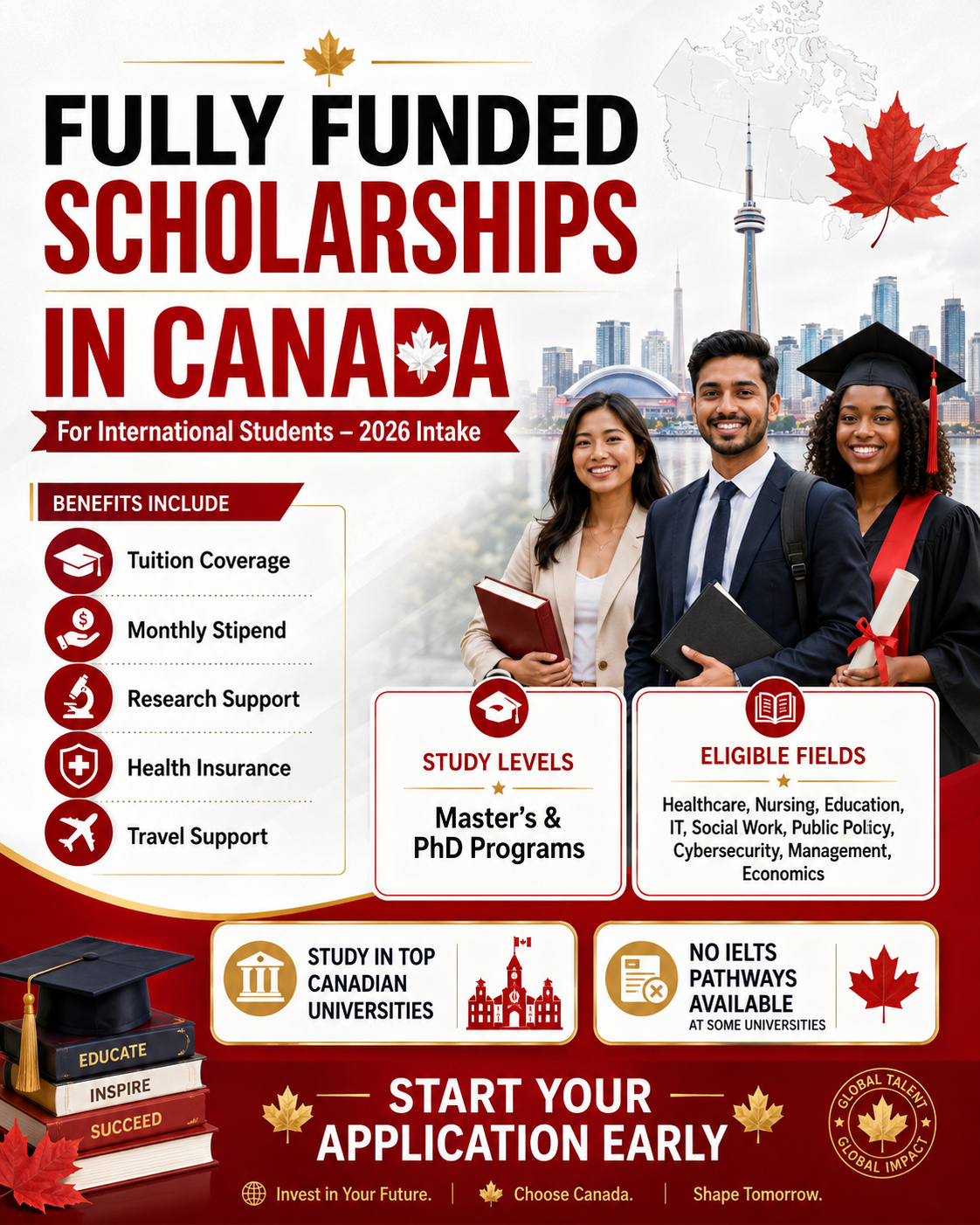
Canada continues to be one of the most generous destinations for international graduate students in 2026, especially if you’re eyeing a career in Nursing, Healthcare, Public Health, Public Policy, IT, Management, or Media & Communication. Below is a carefully researched roundup of 20 fully funded scholarships — 10 national/foundation-funded programs open across multiple universities, and 10 university-specific funding packages — all open to Master’s and PhD applicants, with real application portal links you can click straight through to.
PART 1: National & Foundation-Funded Scholarships (Apply at Any Participating University)
1. Canada Graduate Research Scholarships – Doctoral (CGRS-D)
Level: PhD | Funder: CIHR, NSERC & SSHRC (Government of Canada)
Fields: Healthcare/Nursing (CIHR stream), IT (NSERC stream), Public Policy/Management/Media Studies (SSHRC stream)
Covers: $40,000/year for up to 36 months, non-renewable
Benefits: Open to any citizenship if enrolled in a Canadian PhD program at time of application; fully portable across eligible institutions
Documents: Transcripts (all institutions), research proposal, 2 reference letters, CV, online research-portal application
Eligibility: First-class academic average; enrolled/about to enrol full-time in an eligible PhD program; cannot combine with a prior Tri-Agency doctoral award
Deadline: Internal university deadlines run Aug–Oct (e.g., Waterloo Sept 10, UBC Sept 15); national portal deadline mid-to-late October. 2027 cycle dates TBD.
🔗 Apply here: nserc-crsng.canada.ca – CGRS-D Program
2. McCall MacBain Scholarship (McGill University)
Level: Master’s & eligible professional programs only (not PhD) | Funder: McCall MacBain Foundation
Fields: Over 150 Master’s programs including Public Health (School of Population and Global Health), Public Policy (Max Bell School), Management (Desautels), Media/Communication Studies, and IT-adjacent programs
Covers: Full tuition and fees, $2,300 CAD/month living stipend, relocation grant, summer funding, leadership development program
Benefits: 10 dedicated slots reserved annually for international students; genuinely one of the largest fully funded Master’s scholarships in Canada; no English test required at all if your prior degree was taught fully in English
Documents: Online scholarship application (separate from McGill admissions), 2 reference forms, personal statement, transcripts, then a separate McGill program application
Eligibility: On track to finish or have finished a bachelor’s degree within the last 5 years (or ≤30 years old); must independently qualify for McGill Master’s admission
Deadline: International applicants: August 19, 2026, 4:00 PM ET (for Fall 2027 entry); Canadians/Americans: September 23, 2026
🔗 Apply here: mccallmacbainscholars.org/apply | McGill program info
3. Pierre Elliott Trudeau Foundation Doctoral Scholarship
Level: PhD (1st–2nd year) | Funder: Government-established independent foundation
Fields: Humanities & Social Sciences — strong fit for Public Policy, Media/Communication research
Covers: Up to $60,000–$70,000/year (including a $20,000 travel/research allowance) for up to 3 years, plus mentorship and leadership training
Benefits: Explicitly open to international students already enrolled at a Canadian university
Documents: Online portal application, transcripts (certified translations if needed), reference letters, statement linking your research to the Foundation’s annual theme
Eligibility: Full-time PhD, year 1 or 2; strong public-engagement track record
Deadline: 2026–27 cycle closed Nov 17, 2025; next cycle announcement expected ~September 2026
🔗 Apply here: trudeaufoundation.ca/become-a-scholar
4. Killam Predoctoral & Doctoral Scholarships (Killam Trusts)
Level: Master’s (Level 1) & PhD (Level 2/3) | Funder: Private foundation, administered via Dalhousie, UBC, Alberta & Calgary
Fields: All disciplines, including Nursing, Public Policy, Management
Covers: Master’s up to $42,000/year (max 2 years); PhD $42,000/year (up to 3+ years); international tuition differential often included; relocation allowance
Benefits: Open to citizens of any country; one of Canada’s most prestigious internal awards
Documents: Departmental nomination, transcripts, CV, research statement, reference letters
Eligibility: Strong academic record (~GPA 3.7+/4.3); Master’s within first year, PhD within ~24 months of starting
Deadline: Varies by university (Dalhousie’s recent cycle closed ~Feb 2026) — no direct student application; ask your department
🔗 Apply here: dal.ca – Killam Predoctoral Scholarship
5. Ontario Trillium Scholarship (OTS)
Level: PhD only | Funder: Government of Ontario + participating universities
Fields: Any discipline at Ontario schools (Toronto, Ottawa, York, Waterloo, Western, Queen’s)
Covers: $40,000/year, renewable up to 4 years
Benefits: Designed specifically to recruit top international PhD talent to Ontario
Documents: Standard PhD admission application plus your graduate unit’s OTS nomination form
Eligibility: International study-permit holder; strong academic standing (~A average)
Deadline: Nominations happen in winter following fall applications; check your target school’s graduate office in fall 2026
🔗 More info: University of Toronto OTS page (example — every Ontario university has its own OTS page)
6. Ontario Graduate Scholarship (OGS)
Level: Master’s & PhD | Funder: Government of Ontario + institutions
Fields: All disciplines
Covers: $5,000/term (up to $15,000/year); Master’s max 2 years, PhD max 4 years
Benefits: A dedicated allocation is reserved for international students each cycle
Documents: OGS application form, transcripts, 2 reference letters, statement of interest
Eligibility: Full-time enrolment in an Ontario graduate program; not usable alongside SSHRC/NSERC/CIHR/OTS in the same term
Deadline: 2026–27 cycle: opens ~Aug 24, closes ~Nov 16, 2026 (varies slightly per school)
🔗 Apply here: Carleton University – OGS Portal
7. Quebec Merit Scholarship for Foreign Students (PBEEE / FRQ)
Level: Research-based (thesis) Master’s & PhD | Funder: Fonds de recherche du Québec (Government of Quebec)
Fields: All fields at Quebec schools (McGill, Concordia, Université de Montréal, Université Laval, UQAM) — great fit for Public Policy, Public Health, Management
Covers: Master’s ~$20,000/year; PhD ~$25,000/year; tuition-fee exemption to Quebec-resident rates; health insurance
Benefits: Purpose-built for foreign students, with a genuine tuition break
Documents: Passport ID page, complete transcripts, proof of admission, supervisor’s letter, publications (if any)
Eligibility: Must first be pre-selected by your Quebec university or the China Scholarship Council; no prior PBEEE award; must reside in Quebec during funding
Deadline: Nomination ~Oct 23; candidate submission to FRQ ~Dec 2, 4:00 PM EST (2026–27 cycle). 2027–28 dates TBD.
🔗 Apply here: frq.gouv.qc.ca – PBEEE Program
8. IDRC International Doctoral Research Award (IDRC-IDRA)
Level: PhD (supplementary field-research funding, not full tuition/living) | Funder: International Development Research Centre, via Universities Canada
Fields: Public Policy, Public Health, Media/Communication tied to international development
Covers: Field-research costs (travel, in-country living, data collection) for up to 52 weeks
Benefits: Open to citizens of OECD/DAC-eligible developing countries already enrolled in a Canadian PhD, alongside Canadians/PRs
Documents: Supervisor-approved research proposal, budget breakdown, transcripts, proof of enrolment
Eligibility: First PhD at a Canadian university; research tied to IDRC’s development priority areas/SDGs
Deadline: Rolling annual call — check the official page for the current cycle
🔗 Apply here: univcan.ca – IDRC International Doctoral Research Awards
9. IDRC Research Award (Post-Graduate Paid Fellowship)
Level: For recent (within 3 years) Master’s/PhD graduates | Funder: IDRC
Fields: Public Policy, Public Health, Media/Communication, international development
Covers: One full paid year as a non-union IDRC employee in Ottawa (salary, EI/CPP, paid vacation) plus up to $15,000 in travel/research support
Benefits: A strong launchpad into policy/development careers after your Canadian degree
Documents: Research topic proposal, CV, transcripts, references
Eligibility: Completed (or about to complete) a Master’s/PhD; citizens/PRs of Canada or developing countries
Deadline: Check the current call directly
🔗 Apply here: grad.ubc.ca – IDRC Research Awards
10. China Scholarship Council (CSC) Joint PhD Scholarships
Level: PhD (up to 4 years) | Funder: Bilateral agreement between CSC and Canadian universities (e.g., University of Alberta)
Fields: All fields, including IT, Management, Healthcare
Covers: ~$1,600/month living stipend from CSC; host university covers tuition and fees
Benefits: Near-total cost coverage for Chinese nationals
Documents: CSC application, university admission/supervisor confirmation, transcripts, language proof
Eligibility: Chinese citizenship; admitted PhD candidate at a partner Canadian school
Deadline: CSC’s national deadline typically late March each year
🔗 Apply here: University of Alberta – International Funding & CSC Partnership
PART 2: University-Specific Fully Funded Packages
11. University of Manitoba Graduate Fellowship (UMGF)
Level: Master’s & PhD | Fields: Nursing, Public Health, Public Policy, Management (research-based programs; excludes MBA/MFin)
Covers: Master’s $20,000/year (max $40,000); PhD $25,000/year (max $100,000)
Benefits: Open to all nationalities
Documents: Admission application, transcripts, department nomination materials
Eligibility: Minimum GPA 3.0, full-time enrolment
Deadline: Set by each department individually
🔗 Apply here: University of Manitoba – UMGF
12. University of Waterloo — International Doctoral Student Award (IDSA) & International Master’s Award of Excellence (IMAE)
Level: IDSA = PhD; IMAE = research Master’s | Fields: IT (Math/Computer Science), Health, Management
Covers: IDSA ~$5,140/term through year 3; IMAE $2,500/term for up to 5 terms
Benefits: Awarded automatically upon admission — no separate application
Documents: Standard graduate application only
Eligibility: International study-permit holder, full-time; IMAE requires a thesis-based program. Note: Waterloo still requires IELTS 6.5+ or TOEFL 90+ for admission — no blanket waiver here.
Deadline: Tied to your program’s admission deadline (commonly Jan–Feb)
🔗 Apply here: University of Waterloo – International Student Funding
13. University of Alberta Graduate Entrance Scholarship + Alberta Graduate Excellence Scholarship (AGES)
Level: Master’s & PhD | Fields: All, including Nursing, Public Health, Management
Covers: Entrance Scholarship: $17,500 (Master’s)/$21,000 (PhD) + additional $10,000 for international students; AGES: separate $12,000 one-time payment
Benefits: Both open to international students with a valid study permit
Documents: Standard admission application; department handles nomination
Eligibility: Strong academic record; AGES requires Alberta residency during study and GPA 3.3+
Deadline: Entrance Scholarship nominations ~Jan 10; AGES nominations ~mid-November
🔗 Apply here: University of Alberta Graduate Entrance Scholarship | AGES
14. University of Calgary — Graduate Funding Packages
Level: Master’s & PhD | Fields: Nursing (Faculty of Nursing), Public Policy (School of Public Policy), Management (Haskayne School of Business)
Covers: Varies by faculty — most funded PhD programs guarantee a minimum annual funding floor combining stipend + TA/RA income
Benefits: International students compete in the same internal award pools as domestic students
Documents: Admission application, transcripts, CV, references (award-specific)
Eligibility: Admitted/enrolled full-time; merit-based
Deadline: Internal competitions typically align with September deadlines — confirm with your specific program
🔗 Apply here: University of Calgary – Award Opportunities
15. University of British Columbia — Faculty-Based International Graduate Awards
Level: Master’s & PhD | Fields: Public Health (School of Population and Public Health), Public Policy (School of Public Policy and Global Affairs), Management (Sauder), IT
Covers: Award values set by each faculty; commonly offsets the international tuition differential on top of a base funded-PhD package
Benefits: UBC guarantees minimum funding to most research-based PhD students regardless of citizenship
Documents: Admission application, transcripts, statement of research interest, references
Eligibility: Admitted/registered full-time; GPA thresholds vary by program
Deadline: Varies significantly by faculty — check directly
🔗 Apply here: UBC Graduate Awards
16. University of Saskatchewan — Graduate Funding (IELTS-Flexible)
Level: Master’s & PhD | Fields: Public Policy (Johnson Shoyama Graduate School of Public Policy), Public Health, Nursing
Covers: College/department-level scholarships and teaching/research assistantships assembled per student
Benefits: One of the most IELTS-flexible schools — accepts TOEFL, CanTest, Duolingo, CAEL, or an English for Academic Purposes bridging program instead
Documents: Admission application, transcripts, alternative English proof, references
Eligibility: Admitted full-time graduate student
Deadline: Program-specific
🔗 Apply here: University of Saskatchewan Graduate Studies
17. Memorial University of Newfoundland — International Graduate Fellowships
Level: Master’s & PhD | Fields: Nursing (School of Nursing), Public Health, Management (Faculty of Business Administration)
Covers: Fellowships, teaching assistantships, and tuition-fee reductions assembled per department
Benefits: Widely cited as one of the few Canadian universities that does not require IELTS at all for many programs, accepting alternative English proof instead
Documents: Admission application, transcripts, alternative English proficiency proof, references
Eligibility: Admitted full-time graduate student
Deadline: Program-specific
🔗 Apply here: Memorial University – Graduate Studies
18. Concordia University — International Tuition Award (ITA) & Merit Scholarships
Level: Master’s & PhD | Fields: Management (John Molson School of Business), IT/Computer Science, Media/Communication Studies (Concordia has one of Canada’s top Communication Studies departments)
Covers: ITA reduces international tuition closer to Quebec-resident rates; combinable with PBEEE (#7) for near-full funding
Benefits: Accepts TOEFL, PTE, or Duolingo without an automatic IELTS requirement in many programs
Documents: Admission application, transcripts, English proficiency evidence, CV, references
Eligibility: Admitted full-time international graduate student
Deadline: Program-specific
🔗 Apply here: Concordia University – Graduate Studies
19. University of Toronto — School of Graduate Studies Funded Cohort Package
Level: PhD primarily; select funded Master’s | Fields: Dalla Lana School of Public Health, Rotman School of Management, Munk School of Global Affairs & Public Policy, Faculty of Information (Media/Communication)
Covers: Guaranteed minimum funding package (stipend + tuition offset + TA/RA income), typically in the $20,000–$40,000+/year range depending on division
Benefits: Applies regardless of citizenship for funded-cohort PhD programs; international students also automatically considered for the Ontario Trillium Scholarship (#5) on top
Documents: SGS admission application, transcripts, statement of purpose, references, CV, writing sample (discipline-dependent)
Eligibility: Admission to a funded-cohort PhD program
Deadline: Most priority deadlines fall between December and February for September entry
🔗 Apply here: University of Toronto SGS – Awards
20. Carleton University — International Graduate Scholarships
Level: Master’s & PhD | Fields: Media/Communication (School of Journalism and Communication — one of Canada’s most respected), Public Policy (Norman Paterson School of International Affairs), IT (School of Computer Science)
Covers: Entrance scholarships and assistantship packages assembled per program; also a strong OGS host institution (#6)
Benefits: Carleton is IELTS-flexible, accepting TOEFL, PTE, CAEL, or Duolingo as alternatives
Documents: Admission application, transcripts, English proficiency evidence, statement of interest, references
Eligibility: Admitted full-time graduate student; merit-based
Deadline: Program-specific, generally December–February for Fall intake
🔗 Apply here: Carleton University – Graduate Students
How to Apply — The Realistic Sequence
- Shortlist 4–6 universities in your field and, ideally, contact a potential supervisor months ahead of the deadline — most internal awards here are nomination-based.
- Sort your English test route early. If avoiding IELTS is a priority, target Saskatchewan, Memorial, Concordia, Carleton, or McGill (McCall MacBain) and use TOEFL/PTE/Duolingo or a waiver.
- Apply for admission first — this single step usually triggers automatic consideration for UMGF, Waterloo’s IDSA/IMAE, Alberta’s Entrance Scholarship/AGES, and U of T’s funded-cohort package.
- Layer national funding on top — apply separately for CGRS-D, OGS, PBEEE, McCall MacBain, or the Trudeau Foundation depending on your province and field.
- Track two calendars — your university’s admission deadline and the scholarship/nomination deadline are usually different dates.
- Verify every figure and date directly on the official page before finalizing your budget or study-permit paperwork — Canadian scholarship values and cycles are revised most years.
All figures, eligibility rules, and links above were verified against official university and government sources as of August 2026. Scholarship values, quotas, and IELTS policies can change year to year — always confirm on the linked official page before applying.